The Most Efficient Strength-Training Workout: The New Power Factor Workout
Estimated Reading Time: 8 minutes
TL;DR
There is a way to train strength efficiently — with very high effort and very low volume. The newest version of The Power Factor Workout by Pete Sisco delivers just that: 10 exercises, 2 workouts, and ~2 minutes 30 seconds of high-effort work per week. Done consistently and intelligently, this method delivers serious strength gains with minimal time commitment — perfect for busy professionals in Oakland, Piedmont, and the East Bay who want results without wasting hours in a crowded gym.
Strength Training That Respects Time
Let's be honest: most people don't have 90 minutes four or five days a week to spend lifting. Research shows increasing strength and muscle mass doesn't require that much time — you just need effort, quality, and progression. Short, intense resistance workouts can be as effective as traditional longer sessions when properly structured.
Enter Power Factor Training — a unique system developed and popularized by Pete Sisco that emphasizes maximum effort in minimal time. It's not about endless reps or arbitrary volume — it's about high intensity and strategic selections of multi-joint exercises that train all major muscle groups efficiently.
What Is the Power Factor Workout?
Originally developed to quantify strength using a "power factor" (weight lifted × reps ÷ time), Power Factor Training, like Static Contraction which Sisco developed later, has its roots in limited-range, high-intensity work aimed at eliciting maximum strength responses in minimal time.
While some critics debate the physics behind the original "power factor" calculation, the underlying concept — minimal volume, maximal effort — aligns with well-researched concepts like high-intensity resistance training (HIT), which also uses brief, intense sets to stimulate strength adaptations efficiently.
The newest iteration structures two weekly workouts with ten foundational exercises:
Total-Body A:
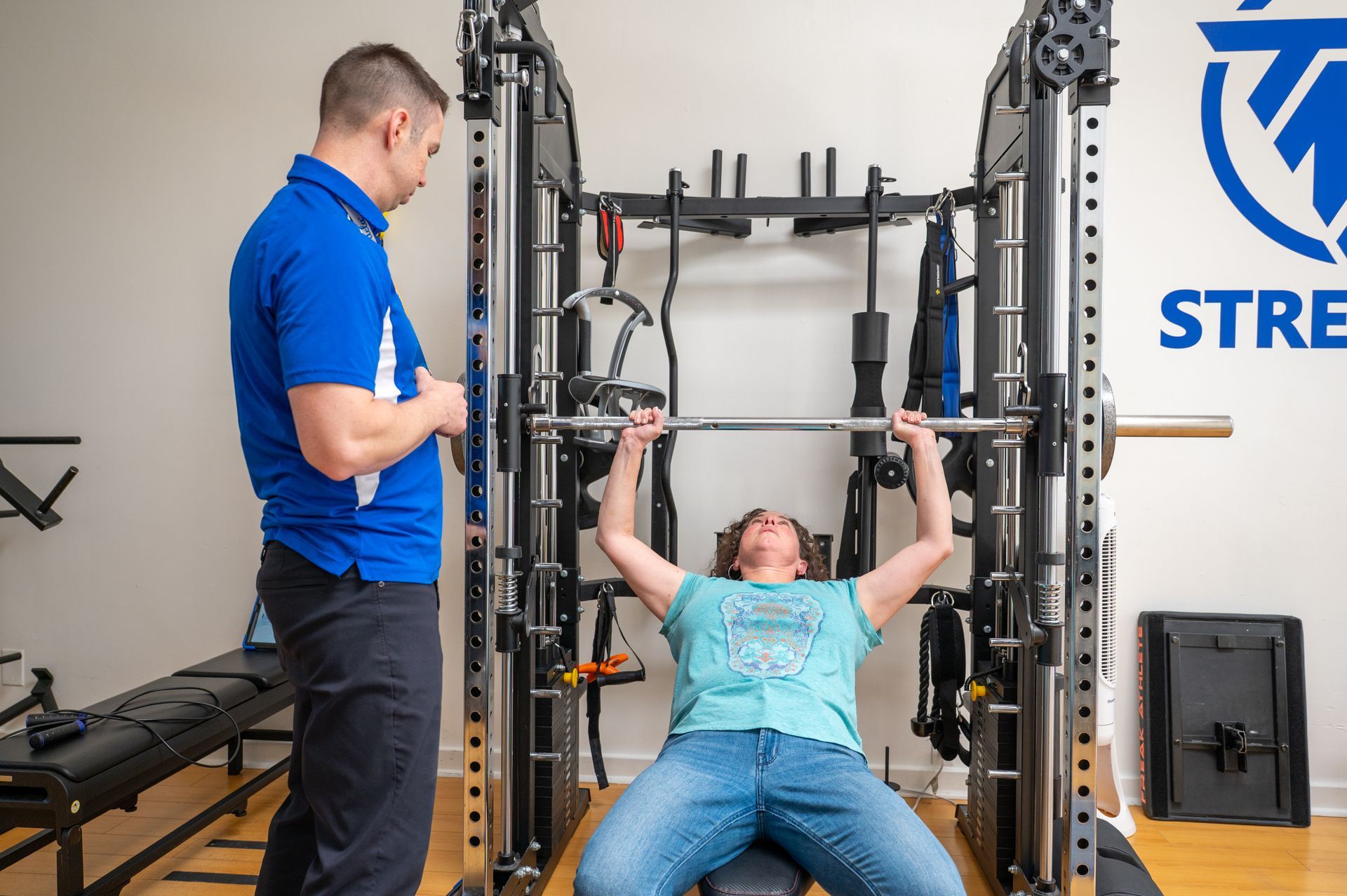
- Chest Press
- Deadlift
- Shrug
- Lat Pull
- Crunch
Total-Body B:
- Shoulder Press
- Curl
- Close-Grip Triceps Press
- Leg Press
- Calf Press
Each workout selects 5 of these exercises, with about 30 seconds of true high-effort work per exercise — meaning each week totals roughly 2 minutes and 30 seconds of intense muscle work.
Why This Is Efficient
Here's what sets the Power Factor Workout apart:
1. Minimal Time, Maximum Effort
Unlike traditional programs that scatter energy across many sets and reps, this format concentrates force production into very brief but extremely intense efforts — a hallmark of high-intensity resistance training.
You'll aim for controlled but maximal effort in each timed interval. That's where stimulus occurs.
2. Strategic Exercise Selection
Each of the ten exercises is a multi-joint compound movement (or a big bang accessory), meaning you train multiple muscle groups at once — and that's efficient training.
Rather than isolating tiny muscles one rep at a time, you recruit entire chains of musculature — shoulders, hips, back, chest, arms, core — with every effort.
3. Built-In Recovery
Strength adaptations happen during recovery, not during the workout itself. By keeping total weekly work low and effort high, you give the nervous system and muscles the rest they need to adapt.
This is especially useful for busy adults in Oakland, Berkeley, and Piedmont who juggle careers, family, and fitness goals.
How the Power Factor Weekly Plan Works
Workout A (e.g., Monday)
- 30 sec — Chest Press
- 30 sec — Deadlift
- 30 sec — Lat Pull
- 30 sec — Shrug
- 30 sec — Crunch
Rest long enough between efforts to maintain true maximal output each interval.
Workout B (e.g., Thursday)
- 30 sec — Shoulder Press
- 30 sec — Curl
- 30 sec — Close-Grip Triceps Press
- 30 sec — Leg Press
- 30 sec — Calf Press
Again — brief effort, sustained intensity.
That's it. That's the weekly strength stimulus.
Recovery Is a Moving Target
Here's the part most people miss: recovery is not fixed. It is not "train Monday and Thursday forever." Recovery is a moving target based entirely on your individual response to the effort involved.
The harder the effort, the greater the recovery demand. And with true high-intensity work — the kind required in the Power Factor framework — recovery becomes the governor of progress.
If you are not getting stronger from workout to workout, that is not a signal to add more volume. It is a signal to add more recovery.
Any time progress stalls, add at least one full additional day of recovery between sessions. If you were training twice per week, extend the gap. If you were training every four days, make it five. Then reassess.
Over time, as loads increase and nervous system demands climb, most people naturally drift toward training once every 7–10 days. Continue to adjust recovery between workouts and continue progressing.
That's not laziness.
That's biology.
Strength improves during recovery — not during the workout. The workout is the stimulus. Recovery is where the adaptation happens.
Respect recovery, and the system works.
Ignore recovery, and progress stops.
Efficient training is not just about doing less work.
It's about doing the right amount — and then getting out of the way.
Scientific Reality: Time Doesn't Equal Results — Effort Does
Science tells us that effort is the driver of strength and hypertrophy, not sheer duration in the gym. Longer workouts aren't inherently superior — intensity matched with recovery and progression is what counts.
Also, well-structured multi-joint exercises are key for efficient strength gains because they:
- Recruit large muscle groups
- Promote neural adaptations
- Stimulate systemic hormonal responses
- Reduce wasted motion
All of which make every second count.
Power Factor Training — A Tool, Not a Dogma
Like all training systems, Power Factor is a tool — not dogma. Some lifters may respond better to higher volume, others better to low-volume high-effort — but for time-pressed, results-oriented adults, this is one of the most efficient frameworks we have.
At TNT Strength in Oakland and the East Bay, we use principles like these — high effort, smart exercise selection, and minimum wasted volume — to design programs that respect your time and deliver real strength gains.
Frequently Asked Questions
Q: Is this really enough training?
A: Yes — when the effort is genuinely high and the exercises are well-selected, even very brief weekly work stimulates neural and muscular adaptations. High-intensity resistance training research supports this efficiency.
Q: What about warming up?
A: A short, joint-specific warm-up is recommended so you can hit each high-effort interval safely. But your total weekly training time will still stay minimal.
Q: Do I need special equipment?
A: No — machines, free weights, or cables work. The exercise list can be adapted to fit commercial gyms or home setups.
Q: How do I progress over time?
A: Increase resistance or effort slightly as you get stronger. Progression is still the central ingredient, even in time-efficient programs.
Q: Can beginners do this?
A: Yes — but beginners especially should emphasize safety, controlled movement, and quality over quantity. Work with a coach if possible.
If you would like to dig a little deeper, there's another resource you shouldn't miss.
Pete Sisco joined us twice on the Truth Not Trends Podcast — Episodes #33 and #67 — and both conversations went deep into the philosophy and application of Power Factor Training.
If this article sparked your interest in Power Factor Training, I highly recommend listening to both conversations. They provide direct insight from the man who built the system — and they reinforce a core principle we apply every day at TNT Strength:
Progress isn't about doing more.
It's about doing enough — and measuring it honestly.
Here's a link to Pete Sisco's book, POWER FACTOR WORKOUT:
https://www.amazon.com/POWER-FACTOR-WORKOUT-Building-Muscle/dp/B0GL32C67R
Pete Sisco's website: https://www.powerfactorworkout.com/
Experience the TNT Strength difference with a free workout.
START YOUR FITNESS TRANSFORMATION WITH A
FREE WORKOUT
Complete the form and we'll set up an appointment for you.
Recent Articles