Detecting, Managing, & Avoiding Over Training!
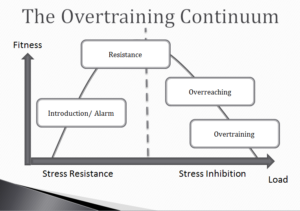
Over training is a problem for many athletes and non-athletes alike. It is not uncommon for people to under estimate the impact that intense and or frequent training sessions may have on their limited recovery resources. Keeping accurate records of all aspects of your training will help you to spot and possibly prevent (or at least minimize) the impact of over training to your current schedule. By closely monitoring the impact that adjustments in volume, frequency and intensity have on your bodies ability to progress and improve, you will learn to create programs which provide optimal results for your efforts.
Below are some things to think about which may help to insure you get the most from your current and future training sessions:

1. Developing Training Tolerances
Physiologically, athletes must begin their training programs slowly and with moderate intensity. Athletes will adapt to the level of overload as training sessions progress. Each athlete is an individual and may respond to the same stimulus differently. The key point is that each individual athlete must be physiologically and psychologically ready to advance to a greater level of intensity otherwise the body will respond with overuse or over training symptoms.

2. Detecting Over training
Over training can be difficult to detect with some athletes. Researchers have found that the over trained athlete exhibits certain physiological and psychological characteristics.
2A. Physiological characteristics
1. Decrease in performance.
2. Decrease in bodyweight.
3. Gradual increase in muscular soreness from training session to training session.
4. Extreme muscular soreness and stiffness the day after a hard training session.
5. Increased minor injuries.
6. Decrease in speed and reaction time.
7. Decrease in coordination and technique of specific training drills.
8. A sudden increase or gradual increase in resting heart rate and blood pressure (when the heart rate is taken each day at the same time).
9. Lowered general physical resistance as shown by continuous colds, headaches, or similar allergic reactions.
10. Decreased appetite.
11. Swelling of the lymph nodes in the groin or armpits.
12. Constipation or diarrhea.
2B. Psychological Characteristics
1. Depression or irritability.
2. Simple chores are a burden.
3. High anxiety level and inability to relax.
4. Unusual sleeping pattern or can’t sleep at night.
5. Decreased eagerness to train.
In addition there are stressors that might affect the athletes training attitude such as family, relationships, academics, jobs, and finance.
3. Responding to Over training
When signs of over training are present it is advisable to suspend training for one or several days or to decrease the intensity and or duration of training for one or several days. If strong signs of over training are present, it is possible that the athlete may have to spend days or possibly weeks at a decreased level of training intensity until physical conditions recover sufficiently to allow extremely hard training to be resumed.
1. Don’t increase intensity, frequency, or duration of training too suddenly, “build up tolerance?
2. Allow adequate recovery between training sessions and cycle the hard, medium, and easy days.
3. Get plenty of sleep (7-9 hours a night).
4. Eat a well-balanced diet that includes all the basic food groups.
5. Short naps may be advised before heavy training sessions.
6. If an athletes heart rate measures above average on a regular basis and it is not recovering to the desired level between workouts, the workload should be reduced to a lower level, or end the training session for the day.
7. Monitor body signs such as resting heart rate, muscular soreness, and muscular stiffness and adjust intensity levels accordingly.
8. REST! Don’t hesitate to give a day or even a few days of rest to the athlete who has been adapting to a higher training level for a period of weeks. You are better off being under trained then over trained.
Remember, consistent hard work is the cornerstone of successful strength and conditioning programs. It pays to know when to work hard and when to take a break. Listen to your body and learn when to step up and when to back off.
Experience the TNT Strength difference with a free workout.
START YOUR FITNESS TRANSFORMATION WITH A
FREE WORKOUT
Complete the form and we'll set up an appointment for you.
Recent Articles